Rinse-and-Repeat: Yet Again, SF Public Employees’ Pension Leaves Billions on The Table
Within three years, SFERS has walked away from $11 billion in no-brainer profits—the equivalent to 70% of SF’s entire budget this year

It’s amazing how San Francisco media outlets skew or censor facts and statistics that don’t adhere to their narrative. For instance:
Did you know there is a moderate running for Nancy Pelosi’s open seat? The Chronicle and other media siteshave ignored Maria Hurabiell as a candidate (Maria is an outstanding alternative to anticar and up-zoner, Scott Wiener.)
The Chronicle keeps counting the 1.7 million people that visited the sandy beach and Ocean Beach waters as having exclusively used the cement park on the Great Highway. Chronicle, you must net out the beach goers from the pavement lovers to produce an accurate cement park number.
Conduct an internet search on how well the San Francisco Public Employees’ pension (SFERS) performed in the fiscal year ending June 30, 2025. No media or legacy media has reported on SFERS’ underperformance.
The public pension’s annual underperformance exceeds the city’s deficit
For the upcoming fiscal year, Mayor Lurie is trying to budget for an expected $900 million deficit. Don’t worry, Mayor Lurie. That’s a small amount. Like last year, I found the funds, while the Chronicle is oblivious.
One year ago, I published an article about how the San Francisco public employees’ pension (SFERS) earned just under 8% for the fiscal year ending June 30, 2024. During that same period, the market, as measured by the Standard & Poor’s 500 Index, was up 22.8%-- almost three times SFERS’ performance. SFERS could have also achieved that easy 22.8% return if they had invested in an inexpensive and efficient S&P 500 Index fund.[i] SFERS’ underperformance cost the public employees’ pension an extra $5 billion from the artificial intelligence’s bull market’s gift. Just $5 billion.[ii]
It was a similar underperformance for SFERS the year before, the June 2023 fiscal year. In 2023, SFERS missed out on a $3 billion opportunity cost.[iii]
Back to the present: For the most recent fiscal year ending June 30, 2025, SFERS just released it’s performance of 7.9%. That embarrassing return was buried on page 62 of SFERS’ annual report. For that same period, the Standard & Poor’s 500 index appreciated 16.2%-- doubling the performance of SFERS! That is, you could have invested the entire SFERS pension in an autopilot S&P 500 index fund, which would have eliminated most of the expensive SFERS administration overhead, and picked up an extra $2.8 billion in appreciation.[iv]
Mayor Lurie, that’s three-times the amount of dollars you are looking for. And for those of you keeping score at home, an $11 billion opportunity loss in just three years—the equivalent of 70% of the City’s entire $16 billion budget this year.
Realistically, a pension should be diversified and have an allocation to fixed income investments (corporate and government bonds) to stabilize the portfolio. So, in my S&P 500 Index example, let’s assume that SFERS had a 30% allocation to fixed income (bonds). We can make this example super-conservative by assuming the fixed income portion of the pension earned absolutely zero interest. If the remaining 70% of the nonfixed income was invested in a static, autopilot S&P Index fund, it would have still trounced the SFERS pension by $1.2 billion.[v]
Why is SFERS yearly performance so poor?
SFERS high salaries are disconnected from the pension’s performance
Despite SFERS’ poor performance, SFERS employees earn the top base salaries in San Francisco
Employee Department Salary
Alison Romano SFERS $722,186
Anna Lang SFERS. $591,338
Kurt Braitberg SFERS $588,745
Dr. Grant Colfax Dept of Health $578,297
Tanya Kemp SFERS $577,490
David Franci SFERS $566,499
SFPD Chief SFPD $416,442
Mayor’s salary Mayor $383,760
Mayor Lurie forgoes his salary and only accepts $1 as compensation
For comparative purposes, Grant Colfax is a doctor. Alison Romano is the head of SFERS yet lacks even the standard resume of either a postgraduate degree or a financial license (CFA, CPA). Despite Romano’s lack of credentials, she was somehow selected from a nationwide search.
These salaries do not include approximately $100,000 in benefits that the employees also receive.
It appears that SFERS is immune to merit. The city bleeds the fund with employees’ salaries that have no connection to their performance.
2. Private equity, the opaque investment where the product creator takes an outsized cut of the profits based on their own self-appraisals
Private equity sounds so exotic, complex, and exclusive and it attracts the financially unsophisticated. Too many interpret private equity as a lifting of a velvet rope to enter. Really, you’ll let me into this private affair? I feel so privileged.
How does private equity or private credit work?
Hypothetical Pension #1 owns 100 shares of Amazon. Pension #1 can assess the value of their investment down to the penny every millisecond of the day.
Hypothetical Pension #2 owns a residential single-family home. On each side of the house, the adjacent homeowners recently sold their houses. Pension #2 can pretty much extrapolate the value of their property compared to the neighbors’ sales prices.
Hypothetical Pension #3 was offered to invest $1 million in an island in the middle of the Pacific Ocean. If there are no nearby comparable sales, how is the value of the island measured? Well, Pension #3 entered a contract where the real estate agent self-appraises the island.[vi] And then the real estate agent generally annually collects 2% of the value of the island, plus 20% of each year’s appreciation– EVERY YEAR! Da ya think that real estate agent has a conflict with his appraisals? The higher the value, the higher his take.
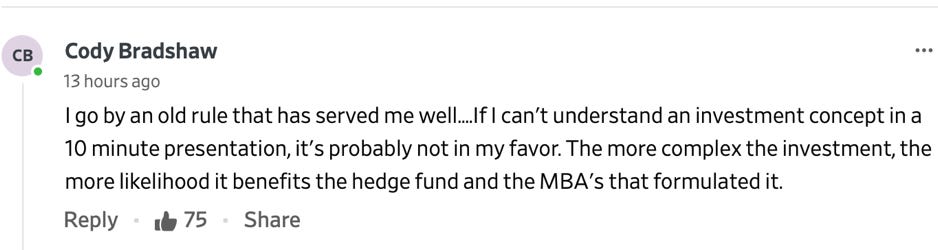
If the agent claims the island appreciated 10%, say $100,000, he collects 20% of that appreciation— or $20,000. Plus, the real estate agent collects 2% of the value of the island $22,000 ($1.1 million x .02) for a total compensation of $42,000, while risking none of his own funds. Oh, and that compensation is taxed at a capital gains tax rate, which is lower than the tax bracket of SF public employees are in. Now you are starting to learn about the opaqueness of private credit and why it takes 7 ½ months for a pension like SFERS to ascertain the value for this private equity junk.
Wall Street Journal comments:

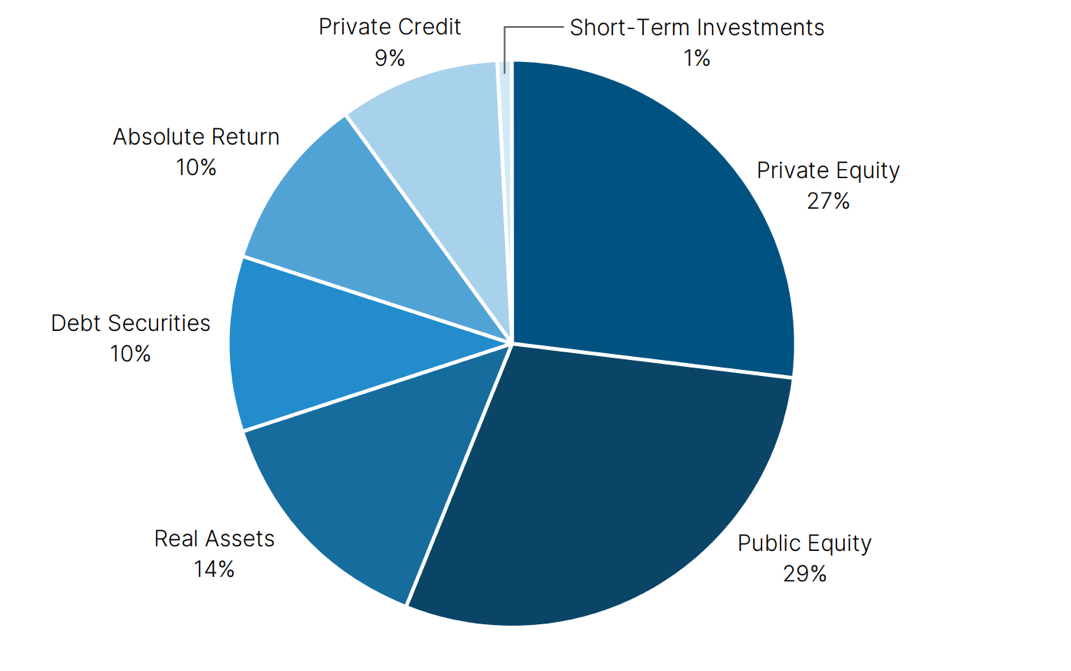
Enter SFERS and they dedicated 36% of public employees’ assets to this questionably preforming investment vehicle. Add in another 10% allocation to similarly structured hedge funds.[vii] Then pay SFERS employee’s exorbitant salaries to monitor these opaque investments and you have a grossly underperforming pension.
3. The merry-go-round of private equity fees lubricate public corruption
SFERS could invest in an S&P 500 fund, reduce high-priced personnel and shave off millions of dollars in fees. But that would create a problem. The fat fees that private equity and hedge funds collect from pensions then gets recirculated into political donations to politicians and (sometimes) SFERS’ independent consultants. Those politicians and one SFERS (now former) consultant[viii] then influence the expensive products that go into the pension that create the underperformance. Switching to index funds would kill the gravy train.
The most egregious example of this corruption was Alfred Villalobos, a former board member of California Public Employee Retirement System (CalPERS) pension. Villalobos left the board and accepted more than $50 million in feesto get (you guessed it) private equity investments into CalPERS. Facing an FBI investigation and impending trial, on January 13, 2015, Villalobos pointed a gun to his head and exited our world. I think he was guilty.
This type of corruption doesn’t happen with index funds and occurs in an environment where the local legacy newspapers rarely investigate public corruption.
K.I.S.S.
Keep It Simple Stupid. SFERS needs to join the 21st century and return to vanilla low-cost investing that strip out the opportunity for public corruption. Stop investing in illiquid investments that have been a performance failure for SFERS. And institute some correlation between performance success and SFERS employees’ salaries.
Wall Street Journal comments:
Note to readers:
When I started writing for the Westside Observer, I primarily covered the underfunded and screwed up SF employees public pension plans. I slipped in a couple articles on SFPD. Tom Anderson, a former SFPD officer, contacted me and shared that “no one is covering the cops’ view, you need to write about it.” Thank you so much, Tom.
Tom’s timing was perfect. SFPD had hired a police chief who commuted weekly from his home in Southern California and had absolutely no vested interest in San Francisco. A pro-crime former public defender slipped through San Francisco’s ridiculous ranked-choice voting to become our DA. And an anticop attorney hoodwinked the mayor into nominating him as the swing vote on the SF Police Commission.
There were many stories to cover. I expanded to the Marina Times and then went totally independent on Substack.
Will Scott, Chesa Boudin, and MCO are gone now. In 2024, the city voted to allow SFPD to chase armed car boosters and utilize license plate readers and drones. DA Brooke Jenkins employed her moderate prosecutorial philosophy, and Mayor Lurie appointed a “street cop” as the Chief of SFPD. The result is that crime plummeted. The new mayor has killed much of the political craziness. The byproduct of this normalness is that there are fewer crime-related stories to write about.
Substack frequently hustles readers for paid subscriptions to my articles. It’s part of Substack’s plan to increase their revenue in preparation of going public. While I appreciate the acknowledgement of paid subscriptions, I have never solicited nor expected readers to pay. I write because I am passionate and pissed off.
I feel presure to accommodate the paid subscribers who are mostly looking for crime stories. However, in the interim, those sexy stories have dwindled.
I am a CPA and a financial advisor, managing an amount of assets that absorbs more than five days of my week. Until there is another pissed-off political or cop issue, my writing is probably going to gravitate to more financially oriented writings.
The city is improving. Please don’t renew your paid subscription based on my history of law enforcement coverage. I won’t be offended if you don’t renew, I’m satisfied enough if you read my articles.
[i] To be clear, S&P 500 Index funds are an inexpensive way to self-manage a portfolio during an A.I. bull market. However, paying fees to an advisory firm just to rearrange the components within a single index is a poor fiduciary decision.
[ii] If we multiply SFERS’ 15-percentage-point underachievement to the 2024’s beginning pension value of $33.6 billion, it totals $5 billion.
[iii] Beginning 2023 pension balance of $33.1 billion x (S&P 500 13.2% less SFERS’ return of 4.2%).
[iv] (Beginning 2025 pension balance of $35.3 billion pension x (S&P 500’s performance16.2%-SFERS’ performance 7.9%).
[v] $1.2 billion calculated as follows: 70% of S&P 500’s 16.2% return equals 11.3% versus SFERS’ return of $7.9%. 2024 beginning pension balance of $35.3 billion x (11.3%-7.9%.)
[vi] Wall Street Journal March 13, 2026. Excerpts

[vii] https://mysfers.org/sfers-annual-report-2025/
[viii] In 2014, documentation was provided to SFERS about an outside consultant’s husband accepting political donations from hedge funds to his campaign in a run for public office in Los Angeles. His wife then approved those hedge funds inclusion in SFERS’ pension.
Great article...well researched. Hopefully, the powers that be will also read this and decide enough is enough...we need a changes at SFERS. All the City employees deserve better financial planning and investing.
1. There definitely some corruption going on at SFERS. The current market doesn’t mirror the returns that San Francisco employees should be getting.
2. Sorry Lou, Mayor Laurie did not hire a street cop. He hired a profession desk cop. The chief of police has a distinguished career behind a desk. And for clarity, being on investigative units does not make you a street cop.