While MTA Squandered Lives with Traffic Reconfigurations, SFPD Was Saving Lives with Fentanyl Arrests
Is Vision Zero really just a distraction from the fentanyl crisis?

Vision zero probability
Vision Zero’s push to eliminate traffic deaths is falsely based on the premise that human error can be eliminated. At the same time, the intentional act of selling drugs to users is rarely viewed as something that law enforcement can affect.
In 2023, there were 26 San Francisco deaths due to traffic accidents.
After the San Francisco Municipal Transportation Agency (MTA) wasted millions to:
· Turn a blind eye to the 50% (at least) of riders that do not pay fares,
· Reconfigure and close streets to car traffic,
· Increase bike lanes,
· Window dress West Portal station,
· Spend $57,602 for a person to count pedestrians and bicyclists over a single weekend on the Great Highway (that’s pencils out to an annualized $3 million salary),
· Prepare to install speed cameras to raise funds from traffic tickets,
· Campaign to close the Great Highway thoroughfare, and
· Donate $1.5 million of taxpayer funds to the bicycle coalition,
MTA’s genius resulted in a 58% surge in 2024’s fatal traffic accidents, to 41.
How can one not draw some correlation between the timing of MTA’s radical street reconfigurations and increased deaths? Yet, all the SF media ink is spent campaigning for more ways to channel more funds to the MTA colander despite a failure to stem fatal traffic accidents since Vision Zero SF was created.
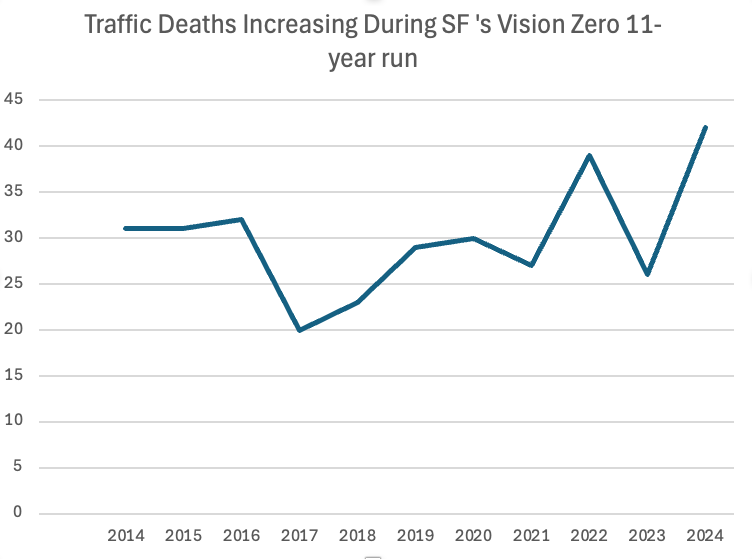
Besides the $1.5 million to the SF Bicycle Coalition, MTA’s main priority has been converting SF car lanes to bike lanes. But how large are the bike fatality numbers in SF?
A perspective on San Francisco bike fatalities
Note the photo (below) portrays the grandeur of the Golden Gate Bridge towers versus the insignificance of man.
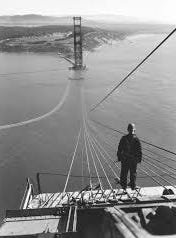
The towers stand 746 feet tall and dwarf the six-foot man. The monstrous disparity between the man’s stature and the Golden Gate Bridge Tower’s height does not even come close to portraying the ratio of San Francisco’s average[1] bike accident deaths to overdose deaths. To accurately depict the ratio of bicycle deaths to fentanyl deaths, visualize that man standing next to three--not one--Golden Gate Bridge towers stacked on top of each other.
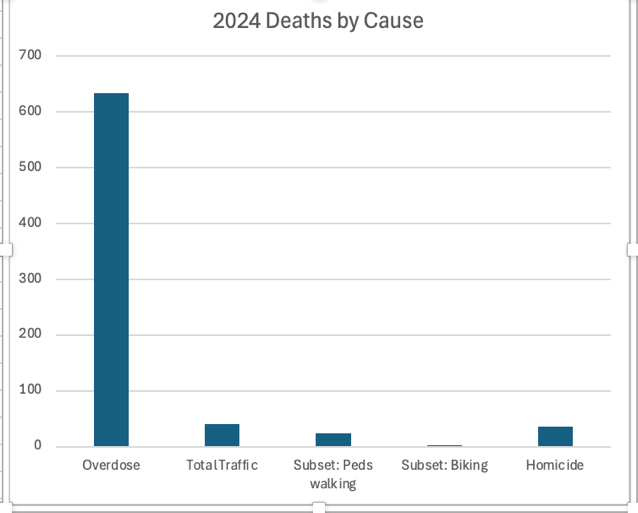
Bicycle Violence (I love hijacking their terms)
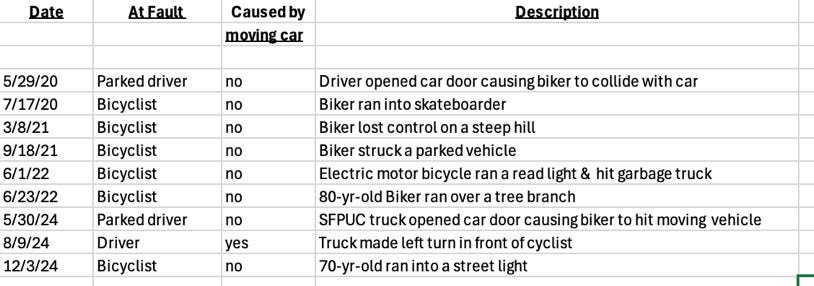
For purposes of this illustration, I assumed bicycle accidents were never the bicyclists’ fault. In fact, of the nine total fatal bike accidents over the last five years, six (67%) were determined to be bicyclists’ fault. Shockingly, with all the money spent to reconfigure bike lanes, over the 5-year period, only a single SF bike fatality was attributable to the fault of the driver of a moving vehicle.
During the same period that MTA was showering the Bicycle Coalition with funds and confusing SF drivers and bicyclists into making the city 58% less safe, SFPD was quietly contributing to a 19% decline in overdose deaths (810 to 633). That is a savings of 177 lives. Shhh! Don’t tell anyone.
SFPD’s dent in the fentanyl trade
Fifteen years ago, seizing a kilo-- of any drug-- was considered a great arrest. If the entire unit brought in a kilo per month, the Narcotics’ captain could boast of the unit’s effectiveness. Two kilos were a gigantic month.
In 2024, not including station operations, SFPD’s Narcotics unit seized twice as much fentanyl[2] as was confiscated along the entire 5,525 mile US/Canadian border. Last year, SFPD Narcotics unit, seized 41 kilos (90 pounds) of fentanyl. Add 40 kilos (88 pounds) of methamphetamine, two kilos of heroin, 9 kilos of cocaine, 26 guns, and half a million dollars in currency. The current narcotics unit is seizing narcotics at four to 6 times the rate of just 15 years ago. That translates to hundreds of fatal overdoses and thousands of nonfatal overdoses saved.
How many nonfatal fentanyl overdoses are there?
While it’s easy to count dead bodies from overdoses, it is much more difficult to ascertain how many people nonfatally overdose each day in San Francisco. Whether we are getting accurate numbers from the city is debatable.
In the late nineties, I worked at the former Tenderloin police station, buried in the bowels of the old Hibernia Bank at Jones and McAllister. While on the streets of the TL, I would frequently converse with JJ-- not his real name. Now, JJ gets around the TL on an electric scooter filming the embarrassing moments that stain our city’s reputation. He publishes his works on Twitter for his 27,000 followers.
On December 27th, JJ’s posted a two-minute video (a must watch: here) on Twitter, viewed by 5.9 million people, which captured the frustration of an SF first responder dealing with the daily assembly line of the city’s nonfatal overdoses.
It seems that nonfatal overdoses in San Francisco have become all too routine. The medic in JJ’s tweet claimed there are 50-60 overdoses per day. Yet, on the SF.Gov website, the city claims there are only 50-60 calls to 9-1-1 per week.
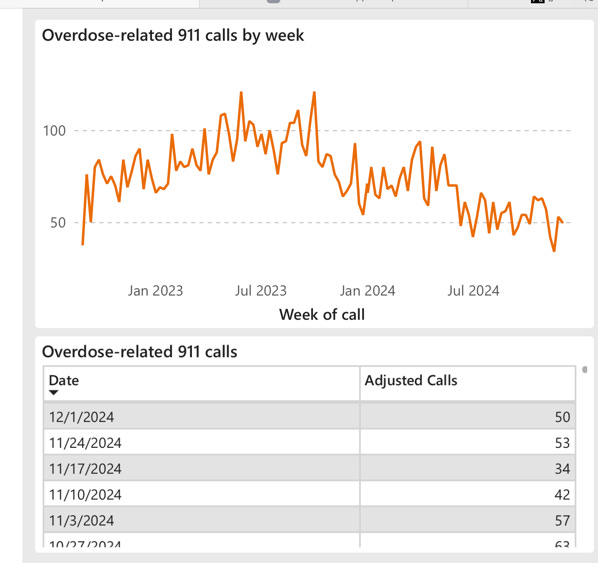
JJ concluded his video with, “there are more overdoses that I see that they don’t count.” I concur with JJ. It seems that the typical and sketchy sf.gov accounting methods are being used to suppress the true size of the problem.
A sampling of a SFPD Narcotics’ two-week run and the common threads
November 19, 2024 (SFPD case #240-722-781)
Prior to this evening, Ortiz and Aris-Escoto, both Honduran nationals, had separately sold fentanyl and methamphetamine to undercover officers. SFPD obtained a search warrant for their house in Oakland. When Oritz arrived in San Francisco on November 19th, he was arrested with a quarter-kilo of fentanyl and two ounces of meth in his backpack. During the search warrant service, in Aris-Escoto’s room SFPD seized ¾’s of a kilo of fentanyl, other drugs, and $15,000 in cash. Chesa Boudin, do you still think Hondurans are trafficked here?
December 3, 2024 (SFPD case# 240-749-252)
Artega and Cardenas-Rosales, both Honduran nationals, working together sold methamphetamine to an undercover SFPD police officer in the Tenderloin. At the time, the undercover officer observed Cardenas-Rosales holding a bag of fentanyl. SFPD officers established the narcotics salesmen resided in Oakland. On December 3rd, SFPD followed the dealers as they drove from Oakland to the Tenderloin. At Pine and Larkin Streets, Artega exited the car to sell in the Tenderloin, where he was arrested by SFPD with a smorgasbord of 4 ounces of fentanyl, one ounce of meth, 10 grams of cocaine power, 10 grams of rock cocaine, and 3 grams of heroin. Cardenas-Rosales was pulled over by SFPD at Pine and Van Ness Avenue with a similar buffet of dope: half a kilo of fentanyl, an ounce of rock cocaine, and ounce of cocaine powder, an ounce of meth, and 36 alprazolam pills. SFPD served a search warrant on Artega and Cardenas-Rosales’ apartment and seized $14,000 in cash. Chesa, do you still think Hondurans are trafficked here?
December 4, 2024 (SFPD Case# 240-751-536)
Hernandez is a Honduran national, had sold drugs to an undercover SFPD police officer, and lives in Oakland. Sound familiar? Hernandez had an outstanding federal arrest warrant from the U.S. Marshalls. SFPD obtained a judge-approved search warrant for Hernandez’s Oakland residence. During the search warrant, SFPD seized over 4 kilos (10 pounds) of fentanyl and over $10,000 in currency. Come on, Chesa. You still think Hondurans are trafficked here?
There’s an obvious common thread here: Honduran nationals, living in Oakland, commuting to San Francisco to sell fentanyl, and in possession of more cash than the average American has in their bank accounts.
Will proactive narcotics enforcement be part of Mayor Lurie’s Fentanyl Emergency
Only a San Francisco public defender or the donut hole Sandinistas wouldn’t draw a correlation between a 19% decline in overdose deaths and SFPD Narcotic’s proactive enforcement. As we learned from ousted-DA Chesa Boudin’s racial profiling, “A significant percentage of people selling drugs in San Francisco, perhaps as many as half, are here from Honduras.”
The Hondurans are only exploiting a San Francisco loophole that there are huge profits in selling fentanyl, while there are few negative consequences. I am not comfortable with the rushed implementation of mass deportation by a president not prone to precision, which appears to include people with no criminal records. And by extension, if Mayor Lurie can justify limiting drug users to a choice between treatment or jail, isn’t it equally appropriate to offer arrested foreign drug dealers a choice between a free flight home or jail?
Nah, let’s divert more taxpayer dollars to MTA so they can convert Van Ness Avenue into a park; install 24-hour metered parking; and charge congestion pricing throughout the city.
Erica Sandberg’s interview with JJ can be found here.
Like actors’ customary appeals at the end of a play, I have two requests:
Request #1: If you would like to voice complaint about the Bicycle Coalition’s outsized control and further plans to cannibalize our streets, please, please spend 20 seconds to send a message to Mayor Lurie, MTA, and the Board of Supervisors: here
Request #2: The radical four of the SF Police Commission are trying to prevent SFPD officers from using certain sections of the California Vehicle Code to conduct traffic enforcement—a Prop 47-type move. Please, please spend 20 seconds to complete this JOT here to let City Attorney David Chiu know that the police commission should not be allowed to choose which DMV sections cannot be enforced. Or here.
[1] 2024 3, 2023 0, 2022 1, 2021 2, 2202 2 = average of 1.6 fatal bike accidents per year. This does not include one electric motor bicycle accident.
[2] The Canadian border amount was fiscal 2024 (ending June 30th) versus a calendar year for San Francisco.
Great article as usual. There is soooooomuch money wasted on ineffective "new" projects. I think that the severely understaffed Narcotics Unit deserves the highest commendation for their efforts. Great teamwork = great results.
Thanks for digging into the details and sharing the results.